
Step off Great Windmill Street, a few paces from the Windmill Theatre, and the noise of Piccadilly Circus seems to fall away. Five oak trees, fully grown when they were craned into place, shade a small square of independent shops and café tables. In the middle stands a bronze sculpture by Tony Cragg, the Turner Prize winner, twisting upwards like a column of smoke. On one side, behind tall warehouse windows, is the Ham Yard Hotel. Newcomers tend to assume the square has always been there. It has not.
A yard with a past
Ham Yard has had more lives than most corners of London. In 1922 a cabaret called Ye Olde Ham Bone Club opened on the first floor above a former stable in the yard, and through the jazz age it drew writers, artists, dancers and actresses; Radclyffe Hall and Jacob Epstein were among the regulars, and the novelist Ethel Mannin called it "chronically Bohemian". In the 1950s the jazzman Cy Laurie ran all-night sessions in a basement at 41 Great Windmill Street, and in 1963 the same address became the Scene Club, the mod venue where the Rolling Stones and the Who played to sharp-suited teenagers.
Parts of the yard had been bombed in the Blitz, and once the music moved on, the site was left to decay. By the time the Kemps arrived, it had been shut away from the city for some forty years: a three-quarter-acre gap in the densest part of the West End.
The vision
Tim and Kit Kemp founded Firmdale in the mid-1980s, when Tim had the idea of turning a tired two-star hotel into something more personal, at a time when banks barely understood what a boutique hotel was. Their debut in the capital, Dorset Square, stood on the site of the original Lord's cricket ground; the Pelham, the Covent Garden Hotel in a former French hospital, and the Charlotte Street Hotel in a former dental warehouse followed. Tim handled the buildings and the business, and Kit, who had trained by working for an auctioneer and an architect, did the interiors. "I never liked the idea of brands," she has said, "so every hotel has to speak for itself."
The couple bought Ham Yard for a reported £30 million, and the whole scheme came to some £90 million, funded partly by selling and leasing back two of their existing London hotels. It was their most ambitious undertaking, and the idea was never simply a hotel. Kit described it as "a little village in the heart of London with shops and restaurants set around a central courtyard". The architects, Woods Bagot, scaled the building to match its Soho neighbours, and a new pedestrian route unlocked Ham Yard and Denman Place between Great Windmill Street and Denman Street. A forgotten site became a public place again.
What makes it unique
The hotel opened on 1 June 2014 as Firmdale's eighth in London. It has 91 bedrooms and suites, each individually designed by Kit Kemp, with floor-to-ceiling windows overlooking the courtyard or the rooftops, plus 24 private residences. Her signature is all over it: confident colour, bold prints, oversized headboards, folk art and craft hung alongside work by established painters, including Eileen Cooper in the drawing room. Nothing goes into a Firmdale hotel, she likes to say, that she would not want in her own home.
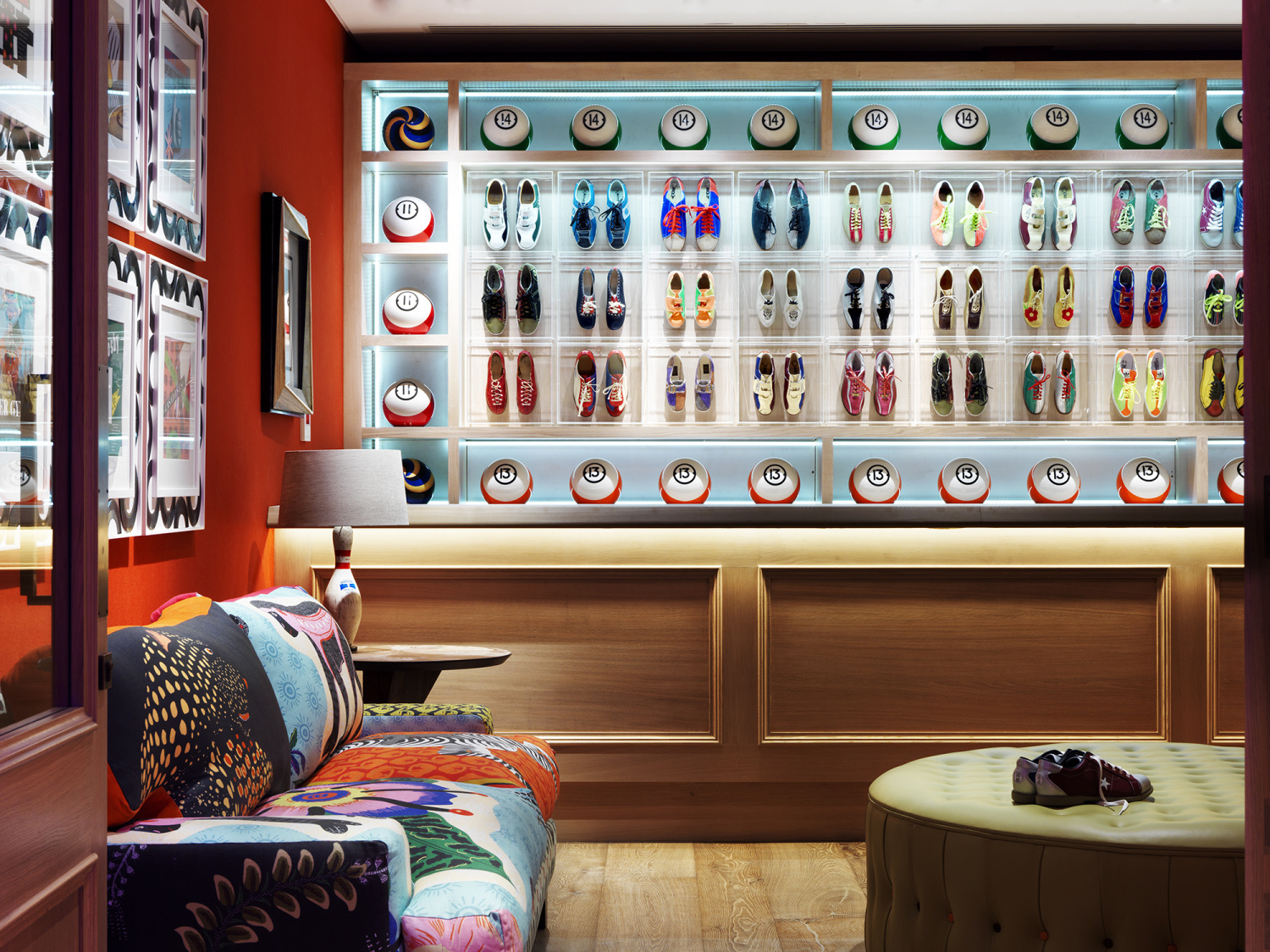
The real surprises lie below ground and on the roof. In the basement is The Croc, a genuine 1950s bowling alley shipped over from Texas and named after the driftwood crocodiles on its walls, complete with a bar and a display of vintage bowling shoes the design team bought on eBay and stuffed with newspaper. Nearby are a 190-seat theatre, a neon-lit Dive Bar for private parties, and the Soholistic Spa. On top of the building is a planted roof garden and terrace with views across the West End, and beehives.
On the ground floor, the Ham Yard Restaurant and Bar spills out onto an outdoor terrace, while the Orangery serves afternoon tea and the Library, for residents, runs on an honesty bar. Sunday brings the Long Lunch. This autumn the restaurant also travels, returning to Frieze Masters in Regent's Park from 14 to 18 October, and from 12 November the roof becomes the Fire Garden for the festive season.
Recognition
The hotel has collected its share of honours. In 2026 it holds two Michelin Keys and was named one of the 50 best places to stay in the UK by The Times. More telling, perhaps, is the way it has become part of Soho's fabric: a venue for film screenings in the theatre, launches in the bowling alley and late drinks under the sky, used by locals as much as by guests.
For the trade, Ham Yard offers several lessons. It shows how a hotel can give something back to its neighbourhood, in this case a public square where there was none. It proves that a single designer's eye, applied consistently to each room, can be a stronger identity than any brand manual. And it demonstrates the value of the unexpected: few guests remember a lobby, but nobody forgets a Texan bowling alley under Soho.
The Hambone Club and the Scene are long gone, but the spirit of Ham Yard has survived them. It is still where Soho comes to meet, to eat, to drink and occasionally to bowl. The Kemps did not just build a hotel on a bombsite. They gave Soho back one of its yards.
Ham Yard Hotel, One Ham Yard, London W1D 7DT | Tel: +44 (0)20 3642 2000 | Website: https://www.firmdalehotels.com/hotels/ham-yard-hotel