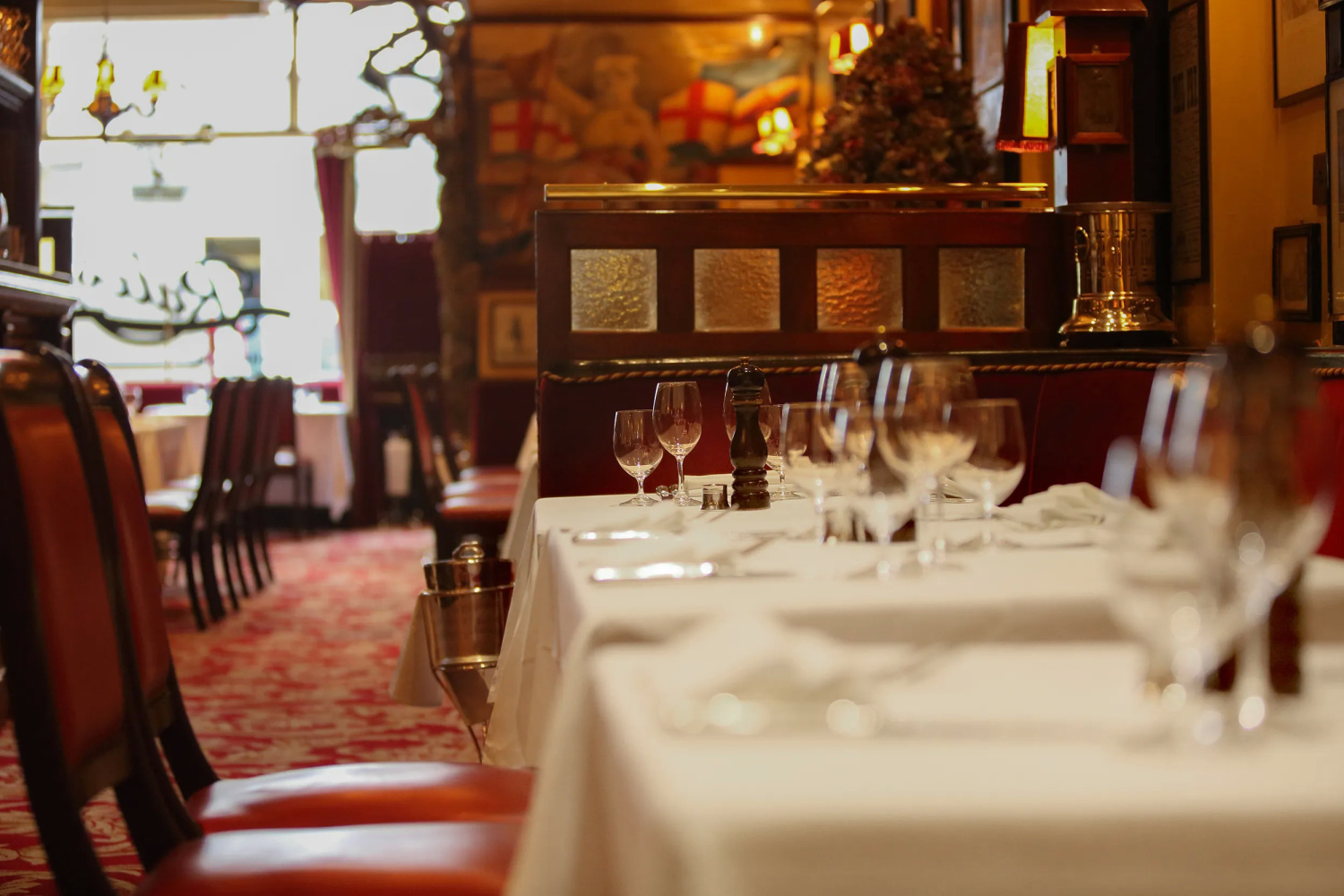
Rules opened on Maiden Lane in 1798, the year Napoleon marched into Egypt, and has spent the two and a quarter centuries since declining, on principle, to change. London's oldest restaurant has outlasted ten monarchs and every fashion in cookery that has come and gone above its head, and it wears the achievement lightly: red velvet banquettes, low light, and prints, cartoons and oil paintings covering every last inch of wall, as though the house had not once thrown anything away. You do not, as the French guidebooks note with a sniff, come to Rules by accident.
It has managed this on remarkably few hands. Thomas Rule, having promised an exasperated family to abandon a 'lurid' past, opened an oyster bar here when Maiden Lane was a grimy corner of town. The Rules kept it until the First World War, when Charles Rule swapped businesses with Tom Bell, who owned the Alhambra in Paris, and decamped across the Channel. Bell's daughter sold it in 1984 to John Mayhew, who later passed the restaurant business to Ricky McMenemy, a man who had worked in it for more than thirty-five years, while keeping the building himself. Even ownership changes hands the way everything at Rules does: slowly, from within, and with the furniture left where it stands.
A gift to the nation
Now the building itself has found a permanent guardian. In October 2026 Mayhew gave the freehold of 34–35 Maiden Lane, valued at some £11 million, to the National Trust, together with its collection of visitor books, old menus, caricatures, photographs, stained glass and signs. The gift makes the property inalienable: the Trust may not sell it. Mayhew presented it as a belated answer to John Betjeman, who in 1971 stood up to defend Rules against a Greater London Council scheme to turn the Strand into a dual carriageway, arguing that Rules had acquired an "invisible atmosphere" no redevelopment could recreate. "The Trust will protect this place in a way that no-one else could," Mayhew said.
At the table, nothing changes. McMenemy continues to run Rules as an independent business, now as a commercial tenant of the Trust, and the rent will help fund its conservation work across the country. He spoke of the security and peace of mind of knowing that "our home will be in very good hands". Rules becomes the first working historic restaurant in the Trust's care, which already looks after 39 trading pubs, among them the George Inn in Southwark. Hilary McGrady, the Trust's director-general, called Rules "an outstanding piece of living history" that has "defied the odds to be standing here today, doors still open and treacle sponge still on the menu". For a trade that has watched Simpson's Tavern locked out by its landlord and countless old rooms lost to rent reviews, it is a model worth studying: a heritage dining room whose bricks are protected for ever, and whose kitchen remains entirely its own.
The kitchen
What the kitchen does better than almost anyone is game, and it does so from a position no rival can match: it has long drawn its birds and venison from its own estate, the Lartington, in the High Pennines — 'England's last wilderness' — where the grouse, partridge, pheasant, wild duck, hare and roe deer are shot, hung properly, and sent south. This is why Rules comes fully into its own between August and February. A bird that has been given its time on the hook, in a kitchen that has roasted pheasant since before the railways, is a different and better creature than the one most tables hurry to the plate.
Around all this sits the rest of the British canon, treated with the same unfashionable seriousness: oysters to start, as they did in 1798; the great suet puddings and pies; calf's liver, Belted Galloway beef, and a steak-and-kidney pudding built around an oyster that regulars will tell you, unprompted, is as good as the form gets. The sweets run to crumble and syrup sponge; the cellar leans French, with a soft spot for the Rhône; and the beer, if you want it, arrives in a silver tankard.
The room
The walls have earned their clutter. Dickens haunted Maiden Lane as a boy; Thackeray, Galsworthy and H.G. Wells ate here; Chaplin and Churchill dined here; Graham Greene liked it well enough to write it into The End of the Affair. Upstairs, by a lattice window, was once the most famous table for two in London — the Prince of Wales's preferred spot for dining Lillie Langtry — now one of a set of private rooms named for the writers who made the house theirs, Betjeman among them. The cinema caught up eventually: James Bond dines at Rules in Spectre, and Downton Abbey filmed here more than once. None of it reads as marketing, because none of it was arranged; it simply accumulated, and now, with the archive in the Trust's keeping, it will stay.
Honesty compels two admissions. One is that Rules is no secret, if it ever was: it fills nightly with visitors, a good many of them American and working through a list, and anyone in search of solitude should look elsewhere. National Trust members, one suspects, will soon be joining the queue. The other is that the cooking, very good as it is, is not the whole point — you come for the room, the game and the theatre of tail-coated service as much as for any single dish, and the birds, when they come, do not come cheap. But to hold either against Rules is to misread it. One does not visit a monument to be surprised.
That is the paradox Rules has dined out on for ten reigns: in a city that treats novelty as the highest virtue, it has grown only more valuable by refusing to supply any. Betjeman warned that its atmosphere would not survive the bulldozer; fifty-five years later, it has been put beyond the bulldozer's reach. Go in the depth of the season, take a booth, order the bird and something suet to follow, and raise the silver tankard to the improbable fact of the thing. London's oldest restaurant is, in the only sense that counts, never out of season.
Rules, 34–35 Maiden Lane, London WC2E 7LB | Tel: +44 (0)20 7836 5314 | Website: Rules Restaurant